


Every month we carefully select additional resources and new support materials to enhance Project Learning Tree’s lessons. These environmental education resources include videos, educational apps and other interactive online tools, books and posters, teacher-generated materials, and more!
Be sure to check back regularly as we continue to add more “EE Resources”. You can also:
- Subscribe to our newsletter to get regular updates
- Register or log in to access all resources, including the student pages for each PLT activity.
For resources that specifically support remote learning, check out this collection COVID-19: Resources, Tips, and Support.
JUMP TO NEW RESOURCES!
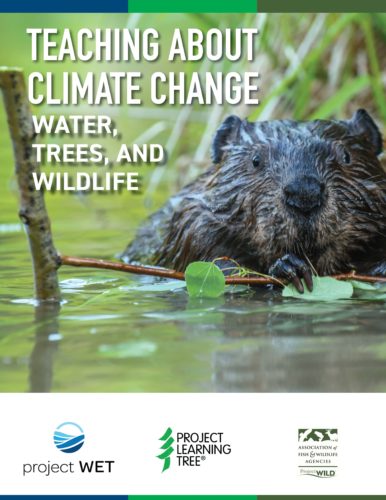
Teaching about Climate Change with PLT, Project WET, and Project WILD
Project Learning Tree, Project WET, and Project WILD have updated our easy-reference resource that lists activities from each of our programs to help teach about climate science and the impacts of climate change.
Use our Teaching About Climate Change: Water, Trees and Wildlife PDF to help plan a lesson series that fits your setting and audience about the impacts of climate change on water, forests and biodiversity. Workshop facilitators for PLT, Project WET, and Project WILD can also use this resource to design climate-focused workshops. Learn more by watching this recorded webinar.
Trauma-Informed Approaches to Environmental Education
Oregon State University’s Trauma-Informed Toolkit, developed by Oregon PLT State Coordinator Yasmeen Hossain, supports and complements educators’ knowledge and skillset in implementing trauma-informed approaches in educational settings.
Online Support Materials for PLT’s Explore Your Environment: K-8 Activity Guide
PLT’s new Explore Your Environment: K-8 Activity Guide includes 50 field-tested, hands-on activities that integrate investigations of nature with science, math, English language arts, and social studies. Get a copy today by attending a local PLT professional development workshop, or you can purchase it directly on shop.plt.org, from Amazon, and other places where books are sold.
My K-8 Guide
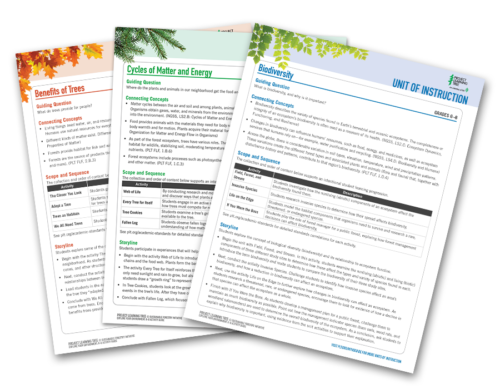 The new K-8 Guide is supported by a free online toolkit and resource hub found at plt.org/myk8guide.
For each activity, you’ll find links to:
- Curated resources (see some examples below)
- Downloadable student pages
- Recommended reading
- Explicit connections to academic standards, including Next Generation Science Standards, and Common Core State Standards—English Language Arts and Common Core State Standards—Mathematics
Each activity provides students opportunities to explore the three dimensions of science: Science & Engineering Practices, Disciplinary Core Ideas, Crosscutting Concepts, and a Guiding Question to drive phenomenon-based, three-dimensional learning, which involves exploring the real world through learner-centered, multidisciplinary investigations that promote inquiry and problem solving.
Other resources at plt.org/myk8guide include:
- Planning an Investigation student page
- Assessment Rubric
- Tips for using Career Corners and Forest Facts
- An online Glossary
- 24 additional Units of Instruction
- And lots more!
Explore Your Environment: Spanish Student Pages Now Available!
Thanks to our amazing partners in Mexico with the leadership of Cecilia Blackallar at the Proteccion de la Fauna Mexicana A.C., we have completed the translation of all Explore Your Environment Student Pages. They are available with your free PLT account. Login at plt.org/myk8guide
New Resources
Nature Health Benefits LIVE
Experience a virtual learning adventure brought to you by the USDA Forest Service and the Natural Inquirer! The benefits of nature on human health is explored in a new set of four videos. Launched as a series in February of 2024, Nature Health Benefits LIVE is now fully available on the Natural Inquirer’s YouTube channel. Explore the videos to learn more about the many health benefits of being in nature.
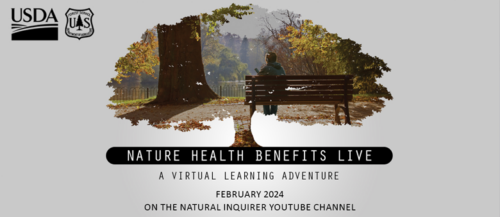
- Episode 1: Nature and Your Physical Health (10 minutes)
- Episode 2: Nature and Your Mental Health (13 minutes)
- Episode 3: A Research Study: Can Greening Vacant Lots Affect Mental Health? (12 minutes)
- Episode 4: Live Q&A. Experts answer questions live! (30 minutes)
Try coupling this content with multiple Explore Your Environment activities, such as Get Outside!, Environmental Health for All, or Forest in the City.
Fresh Finds from the AASA Conference
PLT staff recently attended the American Association of School Administrators National Conference on Education and met some amazing people and organizations, many who offer free educator resources. We wanted to share some of these fantastic finds with you!
Social & Emotional Learning Resources
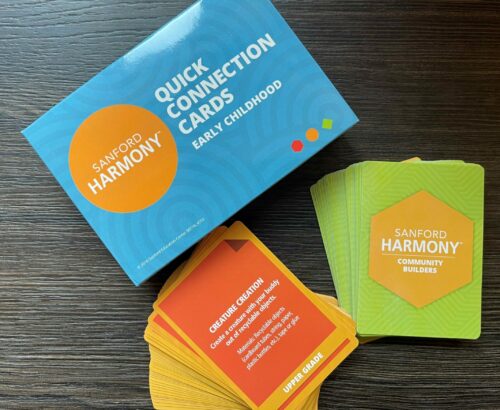 Sanford Harmony, a CASEL SELect Program, provides educators with free resources to promote healthy relationships and student connections. It’s their goal to foster a mutually respectful learning community. Check out their Meet Up Buddy Up Quick Connection Cards which include fun conversation topics and collaborative activities for both early childhood and upper grades.
For example, one of the Connection Cards reads: “If you could choose to be anywhere in nature (e.g., beach, mountains, icecap, desert) where would you be? Why?” This could be a great discussion question to add to the “Get Outside” activity from the Explore Your Environment: K-8 Activity Guide.
In their early childhood cards, one fun buddy activity is to walk down an imaginary trail pretending to help each other through different obstacles you might come across, such as over a fallen tree, walking through mud, or crunching through leaves. This would be a perfect pairing with many of the activities in Trees & Me: Activities for Exploring Nature with Young Children.
Social and Emotional Learning (SEL) is abundant within PLT resources, with exploration activities that encourage communication, teamwork, and creativity. Check out this article from PLT’s Wisconsin State Coordinator, Nicole Filizetti, to learn more about SEL connections to PLT activities.
Energy Education
Looking for high quality energy and sustainability resources? Whether you’re leading the Exploration Energy activity from Explore Your Environment: K-8 Activity Guide or doing the Energy Investigation from our GreenSchools Investigations guide, you can enhance your lessons with resources from Switch Classroom.
Switch Classroom is a free NGSS-aligned supplemental resource that offers ready-to-use lesson plans and engaging online video lessons and activities for teaching energy concepts. With over 500 resources available, including bell ringers, exit tickets, data sets, FRQs, and full-length documentaries, Switch Classroom makes a great addition to your 4th-12th grade science curriculum.
Get tons of amazing information about various topics including renewable resources, energy fundamentals, sustainability and conservation, and more!