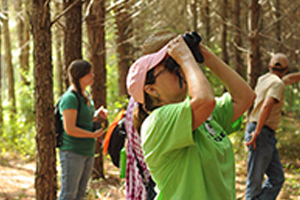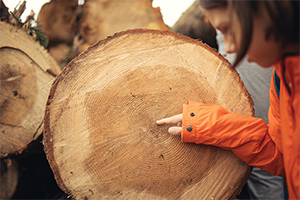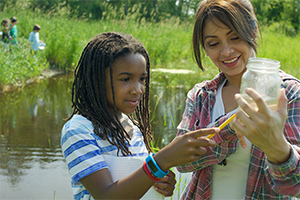

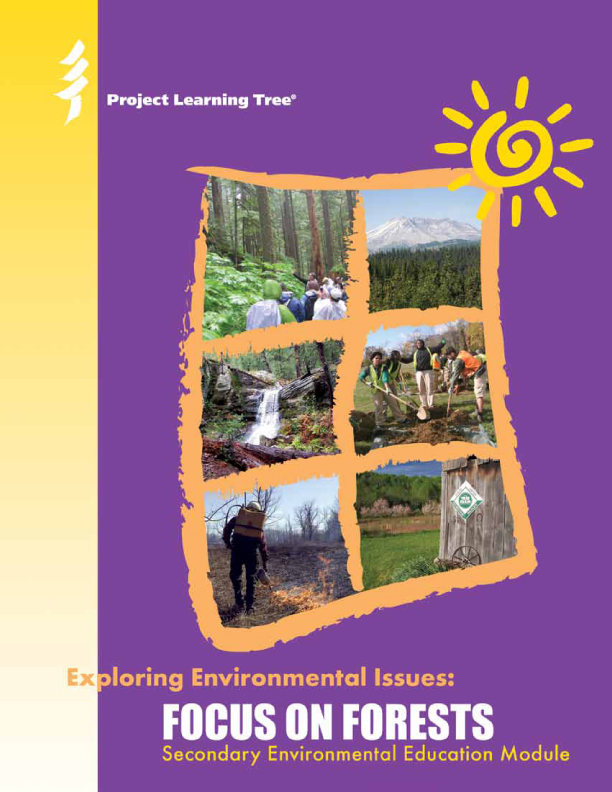
This high school curriculum is designed to foster student understanding of — and appreciation for — the forested lands of North America. The lessons provide students with opportunities for hands-on forest study and address concepts in biology, civics, ecology, economics, forest management, and other content areas.
Students examine ecological systems of a forest; analyze interdependencies within a forest ecosystem; and explore factors, like fire, that shape the development of forests. As students explore forest issues and develop science content knowledge, they develop critical thinking skills and discover the importance of scientific analysis.
“I was thoroughly impressed with the questions provided within these activities, which in turn guided some amazing debates. The discussions and discourse among my juniors and seniors was wonderful! The students and I really learned a lot.”
– Susan Duffy, 11-12th Grade Biology Teacher
Hillsboro High School, Hillsboro, North Dakota
“This curriculum allows students to participate in activities that teach them the job skills of foresters and other natural resources professionals. I like to provide my students with career information that covers the entire spectrum, and they loved the hands-on learning outdoors!”
– Kathey Roberts, 10-12th Grade Environmental Science Teacher
Lakeside High School, Hot Springs, Arkansas
Student Lessons
Activity 1 – Monitoring Forest Health
Students will conduct a forest health checkup of a local forest area, will take forestry measurements, and will evaluate the ecological services provided by trees and forests.
Activity 2 – Story of Succession
Students will learn about succession by studying the reestablishment of ecological communities following the 1980 volcanic eruption of Mount St. Helens and by setting up experimental plots to observe successional changes over time.
Activity 3 – Who Owns America’s Forests?
One of the most critical challenges facing America’s forests today is changing forestland use and ownership. In this activity, students will research forest ownership in the United States, will interview forest landowners about changes they have experienced, and will analyze scenarios to learn about the complexities of intergenerational forestland transfer.
Activity 4 – Tough Choices
We expect forests to provide various ecosystem services, beautiful surroundings for hiking and recreation, wildlife habitats, clean water, and steady supplies of wood and other products. It’s not always easy to meet all of those demands. In this activity, students will read and discuss several short articles and will propose solutions to real-life forest dilemmas.
Activity 5 – The Nature of Fire
Students will learn about the role of fire in forest ecosystems, will examine issues of fire in the wildland-urban interface, and will conduct a wildfire safety assessment in their community.
Activity 6 – Forest to Faucet
Forests provide a variety of ecosystem services and help to maintain a clean and plentiful water supply. In this activity, students explore the connection between forests, watersheds, and their community’s water. Students will identify local watersheds and their forest cover, will analyze a specific watershed in Maine, and will evaluate the extent to which their own community’s water supply is affected by forests and forest management.
Activity 7 – Forest Invaders
Students will consider what makes invasive species a problem for forest ecosystems, will work in teams to present different methods of controlling an invasive species, and will conduct research to find out how invasive species may affect their local forest.
Activity 8 – Climate Change and Forests
Students will use a carbon footprint calculator to analyze their personal effect on carbon dioxide (CO2) levels in the atmosphere, will calculate the amount of carbon stored in a single tree, and will explore how carbon sequestration can affect CO2 levels.
Activity 9 – Words to Live By
The writings of different environmental authors reflect the views of their time periods, as well as their own feelings toward forests. In this activity, students will express their views about forests and will explore different perspectives by reading excerpts from the writings of different authors.
Standards Alignment
Exploring Environmental Issues: Focus on Forests provides a structured alignment to national academic standards. Visit our correlations page to explore connections between Focus on Forests and STEM, the Next Generation Science Standards, and the Common Core State Standards for both ELA and Math.
Get the Materials
- Purchase a Print Guide. Available from Shop.PLT.org or through your PLT State Coordinator.
- Contact your PLT State Coordinator about scheduled in-person workshops in your area, or work with him or her to plan one for your unique setting! PLT’s professional development events are tailored for specific grade levels, academic standards, environmental topics, and formal and nonformal teaching situations. All our offerings are grounded in professional development best practices, designed to meet specific outcomes, and improve student achievement. Learn more.
Additional Resources
- Subscribe to our newsletter to receive notice of new resources that support this curriculum, plus ideas for engaging students with nature in both a formal classroom and nonformal setting.
- To access all resources, including the Student Pages for each activity, register (for free!) and log in.
Please remember that all PLT curriculum materials are protected under copyright law. Reproduce responsibly.
Click here for our Content Reprint and Adaptation Policy.
 This resource was created, in part, with support from the USDA Forest Service and the Idaho Forest Products Group.