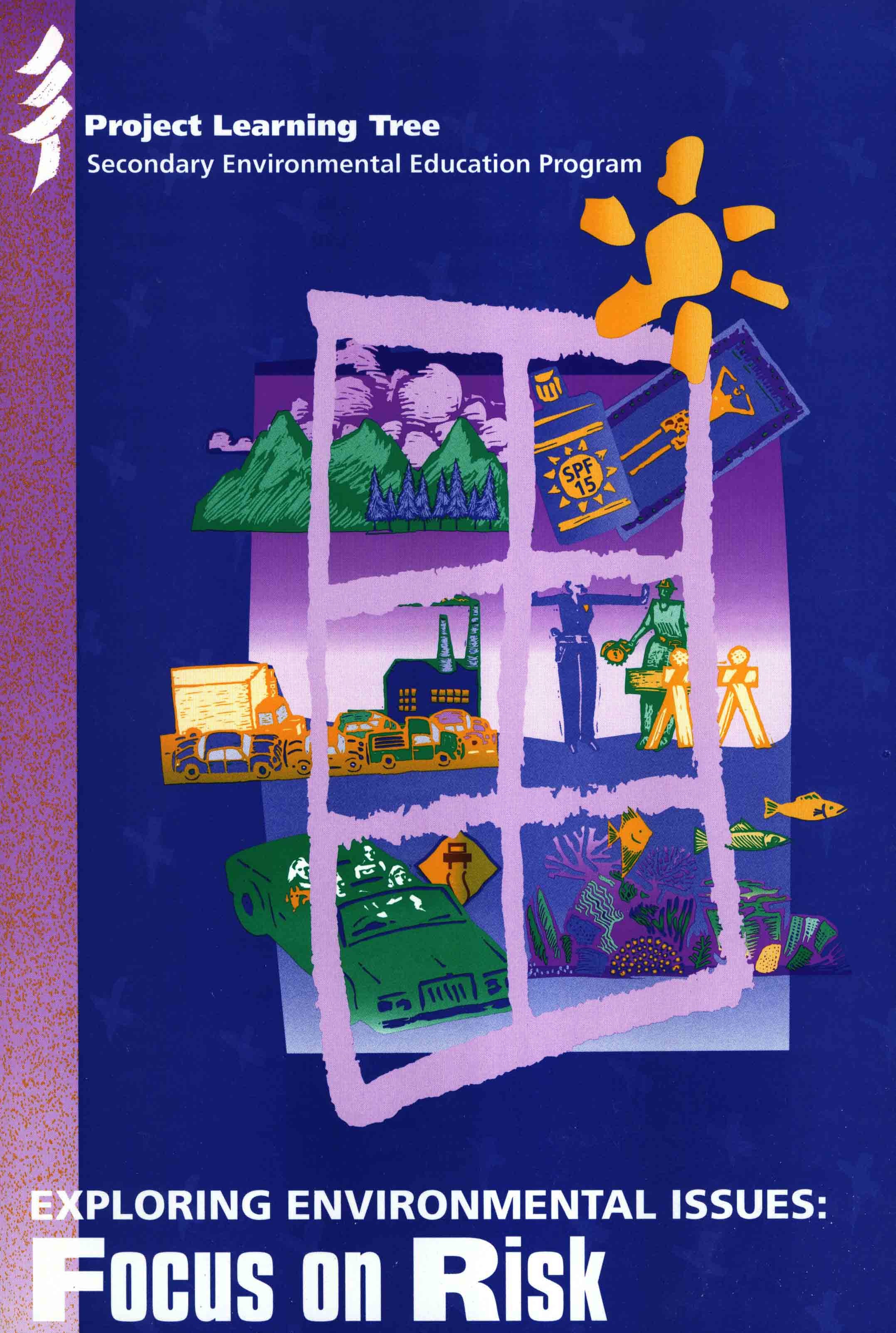
 Exploring Environmental Issues: Focus on Risk helps high school students explore the different aspects of environmental and human health risks that affect their everyday lives. Through eight hands-on activities, students analyze, explore, discover, and learn about risk assessment, risk communication, risk perception, and risk management. There are also three special topics that encourage students to apply their knowledge to real-life risk issues.
“This Focus on Risk program was so beneficial to me— I really saw how these activities could be adapted to different learning styles and curriculum.”
—North Carolina Educator
“Risk is something that my students will have to deal with every day of their lives. These activities gave my students a method of thinking critically about this issue. My students now have a new way of assessing risk in their lives and making decisions based on careful consideration of their choices.”
— New York Educator
Student Lessons
1. What Is Risk?
In this activity, students will work together to explore and discuss risk and its related concepts, as they develop and refine their definition and concept of risk and of risk assessment.
2. Things Aren’t Always What They Seem
Students will identify their perception of the relative degree of risk associated with technologies, environmental hazards, and everyday activities. They will also compare and contrast their perceptions with those of others, including experts and lay people.
3. Chances Are…Understanding Probability and Risk
In this activity, students will conduct a series of experiments, such as tossing coins, to develop an understanding of probability. They will then apply their knowledge of probability to a scenario about the potential risk of using cellular phones.
4. Risk Assessment: Tools of the Trade
In this activity, students will learn about some of the tools used to generate a risk estimate, interpret information generated from using different tools, and understand how the information can be used to set priorities and make decisions.
5. Communicating Risk
This activity allows students to explore how timely and responsible communication among experts, the media, and lay people can lead to improved decisions about risk management.
6. Weighing the Options: A Look at Tradeoffs
In this activity, students will explore the risk management process for personal choices. They will also debate the use of cost/benefit analysis for making public policy decisions using the protection of endangered species as an example.
7. Decision Making: Ecological Risk, Wildfires, and Natural Disasters
In this activity, students will develop and apply decision making skills to various environmental risk scenarios including wildland fires, natural hazards, and threats to coral reefs and mangrove swamps.
8. Taking Action: Reducing Risk in Your School or Community
Students will apply the knowledge and skills they have acquired as they identify a risk in their school or community. Students will develop a plan to assess the risk, decide the best way to reduce the risk, educate others, and, if feasible, implement their plan.
Get the Materials
Attend a training to get Exploring Environmental Issues: Focus on Risk.
- Contact your PLT State Coordinator about scheduled in-person workshops in your area, or work with him or her to plan one for your unique setting!
- Alternatively, secondary curriculum materials on the topics of Biodiversity and Biotechnology can be purchased today from our store.
Additional Resources
- Subscribe to our newsletter to receive notice of new resources that support this curriculum, plus ideas for engaging students with their environment in both a formal classroom and nonformal setting.
- To access all resources, including the Student Pages for each lesson, register (for free!) and log in.
Please remember that all PLT curriculum materials are protected under copyright law. Reproduce responsibly.
Click here for our Content Reprint and Adaptation Policy.