
For those of you who have students working on a science fair project, or doing one project together as a whole class, check out some of Project Learning Tree (PLT)’s hands-on activities for new project ideas. Plus, it’ll ensure you don’t end up with a fair with only homemade volcanoes!
Depending on whether students are required to test a hypothesis (usually in older grades) or you’re simply looking to showcase what students have learned about a topic, PLT’s Explore Your Environment: K-8 Activity Guide / Explora tu Ambiente: Guía de Actividades K-8 has a wide range of activities that incorporate STEM skills and experimentation.
One of the things you’ll find in each PLT activity is an enrichment section, which often features ways to experiment further. Be sure to check those out as there are some fantastic ideas for science fair projects!
Speaking from experience, leading some of these activities at my kids’ school for their annual science fair, students love getting involved, asking questions (so many and so good!), and making hypotheses!
Below are a couple of activities we’ve done, along with minor modifications we made.
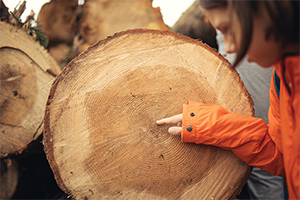
Tree Cookies / Galletas de Árbol
 While this activity is primarily for grades 3-5, we modified it to work for my son’s Kindergarten class. After showing the class a variety of tree cookies and looking at the variations in growth rings, students made hypotheses about what might have happened in that tree’s life. Their teacher then helped them plot their hypotheses (i.e., 5 students thought a branch broke off, 3 students thought that there was a drought one year, and so on).
Because these were little learners, we simplified much of the lesson. When it came time for the school-wide science fair, students shared what they learned about a tree’s life, and then other students (and parents) could make their own tree cookie out of a paper plate. For each year of life, people would draw a ring and mark major life events (e.g., birth, starting school, learning to ride a bike).
Here We Grow Again / Aquí Volvemos a Crecer
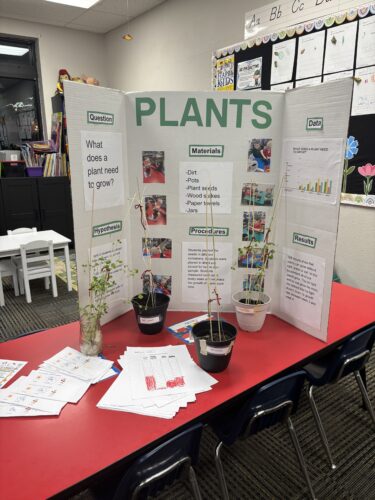
For my other son’s class, we set up an experiment to determine what plants need to grow. We used snap peas as they were quick to sprout. This was a great experiment not only for students to create their own hypotheses, but they got their hands dirty, literally! Hands-on activities like this encourage learners to embrace nature; planting seeds in soil and learning about life cycles.
We set up four experiments to see which plant would grow the most:
- A control (the seed had sun, water, and was planted in soil)
- Seed had sun and water, but no soil (we kept it in a moist paper towel)
- Seed had sun and soil, but no water.
- Seed had soil and water, but no sun
Each student made their hypothesis on a simple sheet of paper – I provided a little handout with icons and the words “No Sun”, “No Water” and “No Soil” underneath so students could select their choice of which experiment would have the most growth. They then plotted them on a graph, and over the course of a few weeks, made their observations.
Additional Project Ideas
If you’re searching for something creative and different than typical science fair projects, look no further than nature and encourage your learners to study our wonderous environment!
Here are a few more PLT activities that are perfect for a science fair:
- Bursting Buds / Brotes
- Soil Builders / Constructores de Suelo
- Water Wonders / Maravillas del Agua
And finally, if the science fair happens to occur during the fall, definitely check out the Signs of Fall / Señales de Otoño as it allows students to see how photosynthesis works and how leaves change color.